The Man Who Thought He Peaked at Forty

The Man Who Thought He Peaked at Forty.
There’s a cartoon going around. A man about forty, slumped in a coffee shop, saying it out loud to a friend: I’ve already peaked. Gary Vee is sharing it.
His friend puts a hand on his shoulder. Forty isn’t halftime yet.
It’s a nice thing to say, and you may have had that thought at two in the morning. But look to what both of them are focused on: Peaked. Halftime. They are reading the same gauge, the one on the dashboard that counts how much is left, and neither of them has looked at the other one.
Nobody ever asks him the question that would help.
How far did you get?
Here is the trouble with years. A year is twelve months long no matter what you do inside it. You can spend one of them building something you’ll still be proud of at eighty, and you can spend one of them answering email, and the calendar will not tell them apart. Two people finish the same decade and end up in places with nothing in common.
So the number everybody tracks turns out to be the number that knows the least about you.
Try distance instead. How far did you get, and pointed toward what.
That question is harder and better. It doesn’t care how old you are. It cares where you started, where you are now, and whether the direction was yours.
And once you’re measuring distance, you notice there are only two ways to cover any.
Why the years you counted tell you nothing about the ground you covered.
Drift (don’t do this)
You know somebody who drifted. You might have been him for a stretch.
Nothing went wrong. That’s the part that makes it hard to spot. He was good at his job, people liked him, the promotions came at the normal intervals. Every year he took the option in front of him, because it was the option in front of him, and twenty of those in a row turned into a career he never once chose.
Drift moves. That’s what makes it so convincing. The odometer spins, the years fill up, and from the driver’s seat it looks exactly like getting somewhere. Ask him at fifty what he was aiming at and he’ll be honest with you: he wasn’t aiming.
That man usually thinks he peaked, too. He didn’t. He never pointed.
Decide (*do this)
The other kind of mile costs the same. Same twelve months, same effort, same tiredness at the end of the day.
The difference is that somebody has hold of the wheel, and they’re steering from something decided in advance. Sherrie Rose calls it enhavim: purpose and mission, led by vision. Vision first, then the mission, then the day’s decisions falling out of both instead of out of whatever showed up in the inbox.
Distance is the measurement. Drift and Decision are the only two ways to get any. Most of us are running some of each.
Past your peak, or nowhere near it? Gearing up, or gearing down?
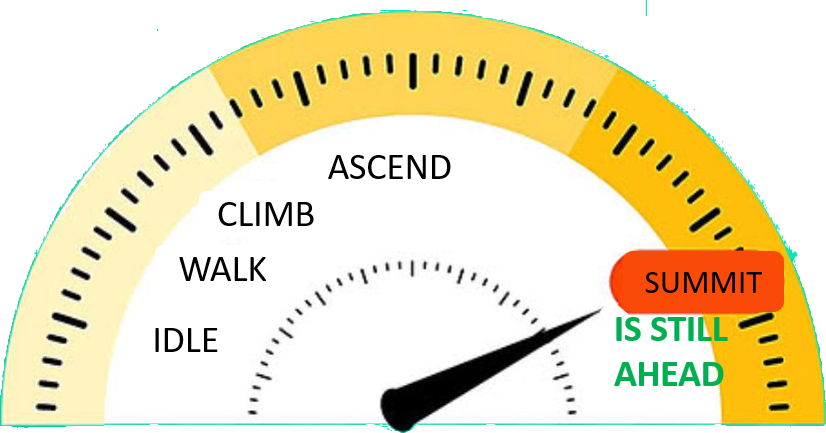
So, toward what? This is DIRECTION.
This is where people stall, and it’s a fair place to stall. Direction is easy to demand and harder to define.
Sherrie Rose defined hers in 2010:
The deeper meaning of Relationship Riches lies in the value of human connection. Relationship Riches focuses on the real value found in meaningful human connection. It’s a reminder that happiness and health are built not on status or accumulation, but on who we share our lives with.
The Real Currency is Relationship Riches. Over sixteen years ago this theme, this motto is reflected in how she is living it and that was long before she had a phrase for it.
Here’s what that looks like on a Tuesday. Sherrie remembers your birthday. Not the app, not a notification, not a reminder she set. Your name came into her head, so she picks up the phone. She’ll go ten miles for someone she cares about when one would have been plenty, and she finishes what she starts rather than leaving it at eighty percent.
That is a direction. It’s also a compounding one, which is the part people miss. Invest in someone and it pays them, and it pays you, and it goes on paying both of you for years.
Margareta Magnusson had her own version of a Tuesday. Every week she poured a gin and tonic and got on a video call with Lola, a friend she’d had since childhood, who lived in Nice. No occasion. No reason. Just the two of them and a drink, once a week, for as long as they both had weeks.
Neither Margareta or Lola waited to be invited. That’s the whole trick, and it’s smaller than people expect.
Before “The Masterwork Years,” the Second Forty Years Put “Life in Your Years” Into Conversation
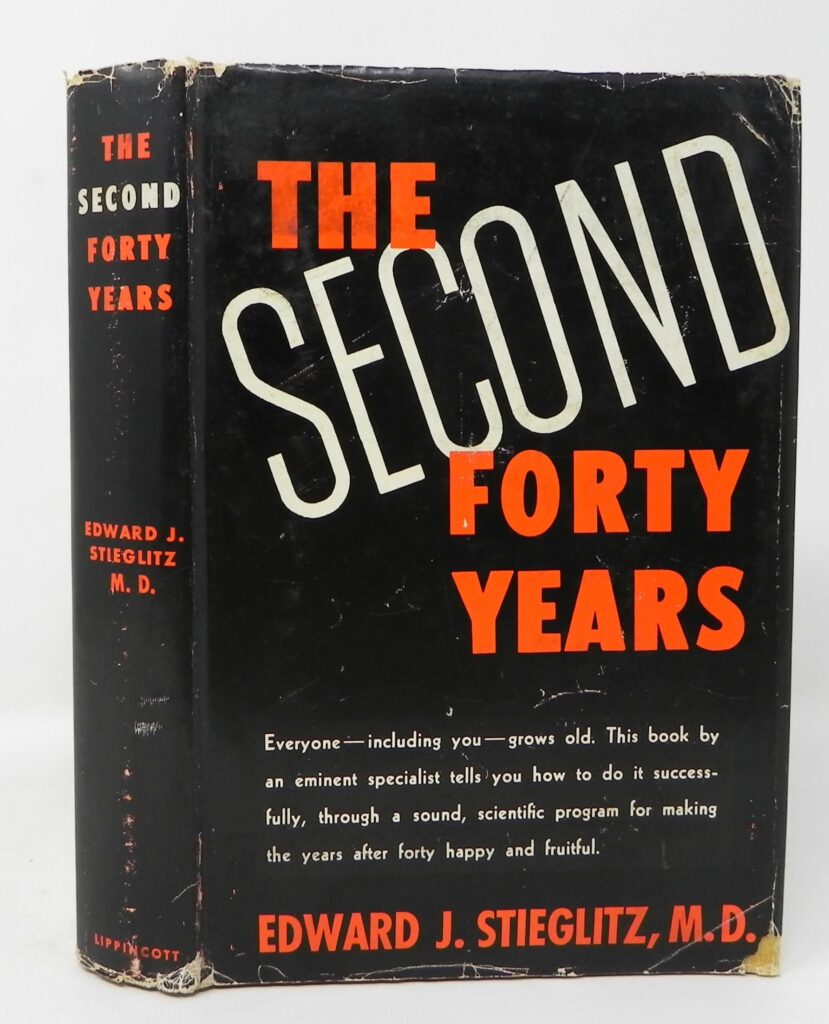
Dr. Stieglitz wrote in 1946 about what happens after the first forty years: aging, health, leisure, relationships, sexuality, and the quality of one’s remaining life. His fundamental premise was that longevity alone isn’t enough; the quality and substance of those years matter. What Sherrie Rose calls “The Masterwork Years.”
The Second Forty Years essentially asks: How will you live the years you have left? Primarily about living well in later years.
The Masterwork Years asks something more expansive: What will you do with what you have accumulated, learned, created, and become? What those years are capable of producing.
That distinction is significant.
In a March 16, 1947 Chicago Tribune advertisement for the book:
“The important thing to you is not how many years in your life, but how much life in your years!”
The Second Forty Years is not necessarily the originator of the underlying idea and Adlai Stevenson later used essentially the same formulation in speeches, including his 1954 Princeton address. By then the wording had become:
“It is not the years in your life but the life in your years that count in the long run.”
Can your friend explain you?
Somebody said your name last week in a room you weren’t in. Did they get you right?
Remarkable, Repeatable, Remembered. Three words, and the middle one is where good people lose it.
Remarkable is the one you’ve probably got. You did something worth noticing, and people noticed.
Repeatable means your friend can explain you to a stranger over coffee without fumbling. She has one sentence, and either it lands or it doesn’t. If she fumbles it, the stranger never comes looking, and remembrance never gets a chance to start.
Most of us have never asked her how it goes.
Here is what Drake shared to someone he wanted to introduce Sherrie Rose to who based on his intuition.
Hello!
You don’t know each other yet, but I have a feeling there could be some real sparks when you do. I wanted to make the introduction and give you a little context about why I think the two of you should talk.
I’ve had the chance to know Sherrie for nearly 15 years. We first connected in a Facebook group focused on online marketing, stayed in touch over the years, and finally met in person about five years ago when I drove cross-country with my son.
Sherrie has an unusual blend of technology and psychology in her background. She worked on m big events like the Los Angeles Olympics and has spent the past four decades working with people and organizations across six continents. She has a way of connecting ideas that normally live in separate worlds: technology, human behavior, business, longevity, wisdom, and what we choose to do with everything we have learned along the way.
She has written six books, and her latest soon to be released, The Masterwork Years, is really the spark behind this introduction.
Her Masterwork is about what happens after decades of building a career, a business, relationships, expertise, and wisdom. Sherrie calls this the Masterwork Years: the stage of life when what you have learned can become something you create, share, and leave in motion.
You can get a better sense of Sherrie here:
And see what she is currently working on here:
https://sherrie-rose.com/likesup/
I had a wonderful conversation with Sherrie this past weekend, and we talked about Masterwork360 Mastermind. After thinking about it, you came to mind as someone who’d be interested. https://Masterwork360.com
There is a big shift happening in the subject Sherrie is exploring, and I think the two of you could have a fascinating conversation about where that shift is taking people, businesses, and the way we think about the next chapter of our lives and work.
So, consider this my introduction. I’ll leave the two of you to take it from here. No need to include me in the follow-up unless I can be of any additional support to two awesome people.
Thank you for being open to the connection.
Cheers
The box in your house
Somewhere in your house there is a box.
It might be photographs. It might be a manuscript at chapter nine, or the recordings, or the notes for the thing you were going to build once there was time. You know exactly which box I mean, and you know roughly which year you stopped adding to it.
Here is the uncomfortable bit. That box isn’t your masterwork. It’s raw material, and raw material has to go somewhere before anyone else can use it.
Assemble, Cultivate, Transmit. Gather it into one place. Develop it into something a person could actually receive. Hand it over while you are still around to explain the strange parts.
Almost everybody skips the first step and then wonders why the third one feels impossible. You can’t transmit a box.
Magnusson came at this from the other end and arrived somewhere useful. She gave the world döstädning, Swedish death cleaning, which sounds grim and turns out to be an act of consideration: sort through your things while you still can, so nobody you love has to do it in a fog, guessing what you meant to keep.
Put the two together and you have the full job. Subtract what nobody needs. Assemble what somebody does. Most houses are full of the first and short on the second, and the two get confused all the time — the box in the closet feels like clutter, so it stays in the closet, when it was the one thing in the house worth developing.
The one day you already have
You have a checkpoint built into every year and you have probably been dreading it.
Your birthday is the only day that arrives asking how far you got. Most people have turned it into a countdown, a number to flinch at. Turn it back into an inventory. One day a year, pull over. Look at the road behind you. Say honestly whether the last twelve months were Drift or Decision, and whether the direction still belongs to you.
Back to the man in the coffee shop
His friend was right that the game isn’t over. He was wrong about the reason it isn’t.
Halftime comes with a whistle. Somebody blows it, both teams walk back out, the second half starts whether or not anyone used the break for anything.
Wisdom has a half-life, and a half-life has no whistle. It fades on its own schedule, unshared, while you wait for someone to signal that your second half has begun.
Nobody is going to blow it. That part is yours.
And the man in the coffee shop hasn’t peaked.
Margareta Magnusson was a Swedish painter who spent her life making things and showing them from Hong Kong to Singapore. She published her first book at eighty-three. She wrote another one at eighty-six, about beauty and friendship and refusing to defer joy, and she was still snatching edges in it. She died March 2026, at age ninety-one.
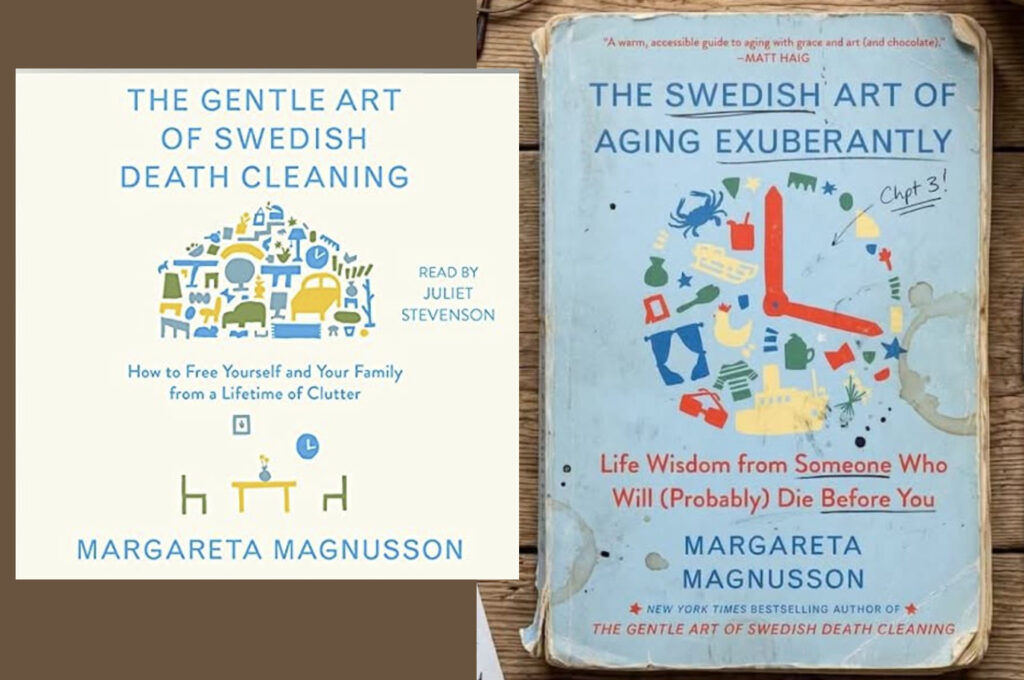
The forty-three years between where he’s sitting and where she started publishing are the years he has already written off.
He hasn’t peaked. Nobody has told him yet what all of it was for.
Sherrie Rose works with high-achievers and legacy-minded leaders to turn decades of experience into Masterwork.
Clarify your purpose and mission led by vision (enhavim).
Between Livelihood & Legacy —That’s Masterwork, Where your Wisdom leaves its mark.™
What’s your Masterwork? — masterwork360.com
Be Legacy Worthy.

Related Summary Read: Guardian feature by Sara Phillips:
Four practitioners who work with people at the end of life — Rachel Clarke (palliative care doctor, Oxfordshire, author of The Story of a Heart), David Holland (palliative care consultant, Norfolk), Tan Ming Li (end-of-life doula, Singapore, founder of the Life Review), and Ruby Love (end-of-life doula, Bristol) — asked what their vantage point taught them about living.
People over things. Clarke: status, house size, car, workplace standing all evaporate at the end; what remains is the people. Holland: patients need to say sorry, forgive me, I forgive you, thank you, I love you — unsaid, these become regret.
Keep career in proportion. Holland values his own deeply. Love has never met anyone who wished they’d earned more or put in more hours.
Pleasure isn’t fulfilment. Clarke: you can eat and drink yourself into a stupor and enjoy it, but joy, awe and wonder run deeper.
Nature. Holland tends a plot of land. Clarke: meaning comes from living connections with the wider world, animal and plant included.
Live with intention. Tan spent years optimizing for no regrets until someone told her that meant she was playing it safe. She switched to filtering by intention.
Small things. Tan grooms her dog herself — hours of it, unproductive by any measure, and she won’t outsource it. Love: appreciate first leaves in spring, a good cup of tea.
Be a completist. Holland’s patients want to hand something over — a business, memories, a house. Finish the novel, sort the albums. Love arranged a small exhibition for a client who’d been a photographer.
Connect. Clarke: charity, teaching, being the loving center of a family, craft given to friends. Holland runs a kids’ football team and invests in village life.
Don’t fear ageing signs. Clarke: wrinkles and grey hair are a privilege sold back to us as a problem. Creaking is evidence you lived long enough to creak.
Health, but not ascetically. Holland sees illness strike for no findable reason. Clarke: try to stay well, don’t punish yourself over good food and wine.
Celebrate birthdays. Tan suggests living funerals — or just a party, balloons, wine, people you love — and marking the big birthdays.
Bucket list, acted on. Clarke wants to see a wild otter; got thousands of puffins instead and counted it. Holland wants Costa Rica with his son. Love wants a baby, more time outdoors, and to get good at focaccia. Her advice: keep goals achievable and regular.
Talk about the death you’d want. Clarke: a good death means peace with the life lived. Love (early thirties) is already planning her own — make the arrangements, put them away, go back to living.
From Guardian story: If you’d like it confirmed by people with no stake in it, the Guardian recently asked palliative care doctors and end-of-life doulas what their vantage point had taught them about living. Nobody at the end brings up their title, or the square footage, or the car. They talk about who they loved. The doctors reached that conclusion at the last possible moment. Don’t wait, start now.
Note: Article edited by AI