
O Captain! My Captain! The Enduring Legacy of Those Who Lead
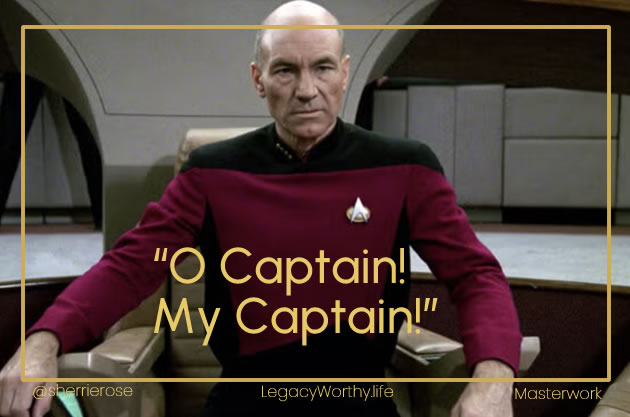
O Captain! My Captain! The Enduring Legacy of Those Who Lead.
From Walt Whitman’s tribute to Abraham Lincoln to Dead Poets Society and Captain Jean-Luc Picard (Patrick Stewart), the image of a captain reminds us that great leadership lives on in those it influences.
“O Captain! My Captain!”
Four words. A declaration of admiration, affection, loyalty, and loss.
Walt Whitman wrote them in 1865, following the assassination of President Abraham Lincoln. The poem is one of the most recognizable in American literature, and it uses the image of a ship’s captain to represent a leader who guided a nation through its darkest voyage.
The ship had survived. The journey was complete. Victory was within reach. Yet the captain lay dead on the deck, unable to share in the celebration.
The word my makes all the difference. It conveys a relationship between a leader and those who follow, built through trust, admiration, and shared experience. Whitman’s opening words acknowledge, in the most personal terms, a leader whose influence reached far beyond the authority of his position.
That sentiment found new life more than a century later in an unforgettable film.
When a Teacher Becomes a Captain
In the 1989 film Dead Poets Society, Robin Williams plays John Keating, an unconventional English teacher at a prestigious boarding school. Through poetry, literature, and his insistence on independent thought, Keating inspires his students to see life differently.
He introduces them to carpe diem, seize the day, and challenges them to find their own voices rather than conform to expectations. He also offers them a name for him: Mr. Keating, or, for the slightly more daring, “O Captain! My Captain!”
In the closing scene, Keating is forced to leave the school. As he returns to collect his belongings, one student stands on his desk and says those words aloud. Others follow, standing on their desks in a quiet but powerful show of loyalty.
The scene moves us because the students understand something the institution does not: a teacher’s influence cannot be taken away by dismissing him.
Whitman’s poem mourned a president whose life ended as his nation’s great struggle reached its conclusion. In Dead Poets Society, the same words honor a teacher whose work continues through the lives he touched.
Another Captain Takes the Bridge
Another captain deserves a place in this conversation: Captain Jean-Luc Picard of the USS Enterprise, played by Sir Patrick Stewart in Star Trek: The Next Generation.
Beginning in 1987 and across seven seasons, Stewart brought intelligence, composure, moral conviction, and humanity to the role.
Picard was a different kind of television captain. His authority rested on listening, weighing opposing viewpoints, encouraging independent thinking, and trusting those around him to use their own judgment. He was a diplomat, philosopher, explorer, mentor, and commander, and his leadership was grounded in the belief that knowledge, reason, respect, and individual dignity matter.
His commands, “Make it so” and “Engage!”, became part of popular culture. His most memorable moments, though, often came when he paused to consider a hard question, defend a principle, or remind his crew of their responsibilities to one another.
Like John Keating, Picard understood that leadership means developing the capabilities of others. A good captain creates the conditions in which people can think, contribute, and grow, and has no need for everyone to think alike.
Like Whitman’s Captain, Picard became far more than the person in the command chair. He became a figure people trusted and admired.
Remembering Sir Patrick Stewart
Sir Patrick Stewart died on October 28, 2026, at the age of 86. The news was announced on October 29, closing a career that spanned more than six decades.
For millions of viewers, Captain Picard will remain his defining role. His classical Shakespearean training, commanding voice, and gift for conveying thoughtful authority gave Picard a presence that rose above the science-fiction genre. Decades after The Next Generation ended, he returned to the character in Star Trek: Picard.
There is something poignant about remembering him alongside Whitman’s poem. The actor who brought one of television’s most respected captains to life has taken his final bow.
The character remains. The performances remain. The ideas he delivered through Picard keep reaching new audiences.
A captain may leave the bridge, but the example set during the voyage continues to guide those who remain.
What Makes Someone Worth Calling Captain?
These three stories offer different views of leadership.
Abraham Lincoln led a nation through civil war. John Keating encouraged young people to think independently and discover their potential. Jean-Luc Picard commanded a starship while showing the value of reason, integrity, and respect.
Their circumstances could hardly differ more, yet they share one quality: their influence extended beyond their immediate responsibilities. They left something in the people who encountered them.
That is the deeper meaning of Whitman’s opening line. “O Captain! My Captain!” acknowledges a relationship that made a lasting difference.
We remember leaders for what they accomplished, and we remember them for what they awakened in others: courage, curiosity, conviction, imagination, and the willingness to think for ourselves.
The voyage may end. The captain may be gone. The influence of a life well led can continue through generations.
O Captain! My Captain!
Some words never lose their meaning.
Who was the captain in your life?
This post written in honour of Patrick Stewart born July 13, 1940, Yorkshire, UK, died October 28, 2026 in Los Angeles, California, after a brief episode with Alzheimer’s disease and Lewy body dementia
Notable Roles: Captain Jean-Luc Picard (Star Trek: The Next Generation, Star Trek: Picard, and films) and Professor Charles Xavier (X-Men films). Read more about his career in the obituary by The Hollywood Reporter and tributes from his Entertainment costars.