
Six Degrees of Separation

Six Degrees of Separation
The idea that every person on Earth is connected by only a handful of social links with “six degrees of separation” has become a popular concept of the modern age. Today it feels almost obvious. Social media collapses distance. Professional networks overlap. Viral posts leap across continents in hours. Yet the original idea came from a far more analog world built on handwritten letters, postal routes, and personal acquaintances.
The phrase “six degrees of separation” traces back to experiments conducted by psychologist Stanley Milgram in the 1960s. Milgram wanted to test what he called the “small world problem.” His question was deceptively simple: how many personal connections separate one stranger from another?
To explore it, Milgram recruited ordinary people in the Midwest and asked them to send a package to a target person in Boston. There was a catch. Participants could only forward the package to someone they personally knew on a first-name basis, and each recipient had to continue the chain in the same way.
What happened surprised participants and researchers.
Some chains failed entirely. Others moved remarkably fast through social networks that seemed invisible at first glance. The successful chains reached the target in an average of about six steps. The finding suggested that society was far more interconnected than people assumed.
The experiment became foundational to modern network theory. It influenced research in sociology, computer science, communications, and eventually social media itself. Long before LinkedIn connections and mutual Instagram follows, Milgram demonstrated that human networks already formed a tightly woven web.
Decades later, the idea escaped academia and entered popular culture.
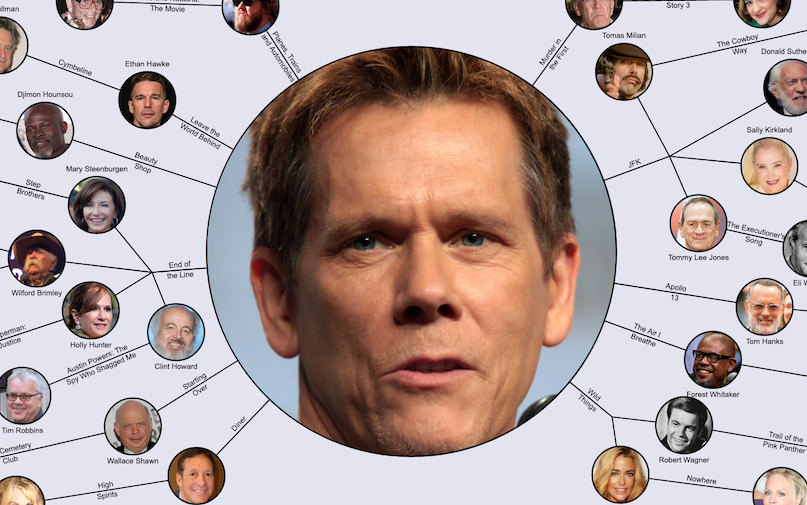
Playwright John Guare popularized the phrase with his 1990 play Six Degrees of Separation. Soon after came the game “Six Degrees of Kevin Bacon,” a pop culture phenomenon built around the same small world theory. The title, based on the concept that any two people are connected by six or fewer acquaintances, became a lasting pop-culture phrase following the play’s success.
The game argues that any Hollywood actor can be connected back to actor Kevin Bacon within six steps through shared film appearances. Created in 1994 by three college students, the idea came after they noticed Bacon seemed to appear in films connected to nearly everyone in Hollywood. The challenge became finding the shortest chain between any actor and Bacon using shared movie credits.
For example, an actor might have appeared in a film with another performer, who appeared in another film with someone else, eventually leading back to Bacon. The game became so popular that databases and online tools emerged to calculate “Bacon numbers” automatically.
Ironically, Bacon initially disliked the concept because he worried it reduced his career to a joke. Over time he embraced it and eventually launched SixDegrees.org, a charitable initiative designed to use human connections for social good.
What made the concept stick was not just novelty. It matched lived experience. Most people have had moments where distant worlds unexpectedly overlap. A stranger turns out to know an old friend. A colleague once worked with your cousin. Someone across the country shares a direct connection to your neighborhood.
The internet amplified the phenomenon. Studies conducted through email and later through social networks suggested the world may actually be even more connected than Milgram imagined. Researchers analyzing massive online networks found average separation distances shrinking closer to four degrees in some systems.
Still, the deeper insight of Milgram’s work was never really about numbers.
It was about hidden structure.
Human beings tend to imagine society as fragmented into isolated groups. Milgram showed that those groups are bridged by countless weak ties. One introduction leads to another. Information, influence, and opportunity move through these invisible pathways every day.
In many ways, modern culture is built on this reality. Careers emerge from introductions. Ideas spread through networks. Movements gain momentum person by person. The architecture of connection shapes far more than people realize.
The phrase “six degrees of separation” survived because it captured something larger than an experiment. It gave language to the idea that the world is smaller, denser, and more interconnected than it appears from the surface.
Sources
https://psychology.fas.harvard.edu/people/stanley-milgram
https://www.psychologytoday.com/us/articles/200311/six-degrees-separation
https://www.scientificamerican.com/article/e-mail-study-corroborates/
https://en.wikipedia.org/wiki/Six_degrees_of_separation
https://en.wikipedia.org/wiki/Six_Degrees_of_Kevin_Bacon


Is your LEGACY on the Green Line?

Are you ready to turn up your wisdom?