
The Best Advice in Mark Twain’s 70th Birthday Speech Is the Part He Ignored
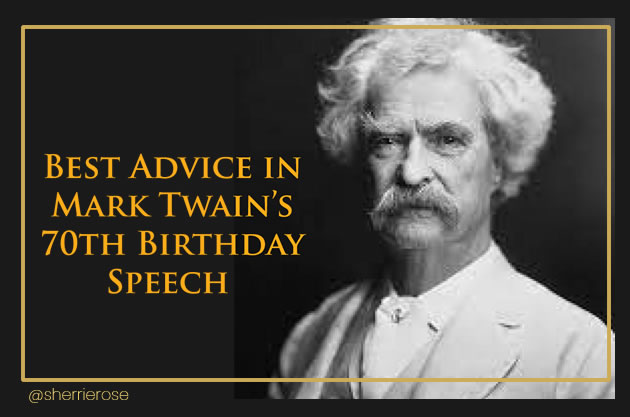
The Best Advice in Mark Twain’s 70th Birthday Speech ( Is the Part He Ignored).
At Delmonico’s on the night of December 5, 1905, with the biggest names in American letters seated around him and the cigar smoke already thick, Samuel Clemens (Mark Twain) stood up to accept a toast to his seventieth birthday and spent the better part of an hour telling the room that his life was no model for theirs.
He began with the cigars, sixty years of them, waking in the night for the pleasure of another and never once refraining while awake. He moved on to his diet, eleven hours between meals for thirty years, which suited him and would suit almost no one else. Then exercise, of which he had taken none and intended to take none ever again. Each habit came with the same warning attached, delivered as comedy but repeated too often to be only that: his habits protected his life, he said, and would assassinate anyone who borrowed them. Midway through he built an elaborate joke around a secondhand moral he had picked up cheap as a young man and spent sixty-three years growing into something the size of a museum exhibit, which is a joke about how slowly character actually forms, with no shortcut available and no schedule to follow.
Sitting inside all that clowning is the best line of the night, and he says it twice: we can’t reach old age by another man’s road.
That is the advice. It is genuinely good advice, offered by a man who had earned the right to give it, and it is the one thing in the speech he abandoned before the evening was over.
Minute Sixty
Clemens turned from his habits to the number itself, and the whole thing changed direction.
Seventy stopped being his own peculiar accomplishment and became a threshold with the same meaning for every guest at the table. The strenuous life was over, he told them; he had been mustered out, a time-expired man, and what remained was the chimney corner, a pipe, a book, and the courteous work of watching the younger diners sail on toward the sinking sun.
An hour after insisting that no two roads to old age resemble each other, he drew a single road and seated the entire room on it.
Calling that a contradiction is easy and not very useful. What makes the turn worth studying is that Clemens was neither confused nor careless with his own thinking. He did what most people do when a birthday lands on a round number: he lived by a well-earned principle for an entire speech and then set it down for the one paragraph in which it applied to him directly.
Why the Chimney Corner Made Sense That Night
The paragraph he reached for was not arbitrary, because it was the only one that Twain’s era the arithmetic supported.
A child born in the United States in 1900 could expect to live to roughly 49, a figure pulled down hard by infant mortality, though even adjusting for that, a man who arrived at seventy had outlived most of the people he grew up alongside. No template for a productive seventy existed in 1905 because there was barely a demographic category for a living seventy. Closing his speech by undercutting his own opening hour, Clemens reached for the one script the actuarial tables of his day actually backed.
He then declined to follow it. Five more years of writing and lecturing followed that dinner, all of them recognizably Mark Twain, so that his own conduct spent the rest of the decade demonstrating the very thing he had said before talking himself out of it. There is no one road, not even for the man giving the toast.
The Script Outlived the Statistics
By 2000, American life expectancy had climbed to nearly 77, close to thirty years past anything Clemens could have known, and the chimney-corner ending he reached for no longer describes the reality it once did.
The reflex behind it has proved more durable than the arithmetic that justified it, and has mostly changed clothes rather than disappeared. Leadership coaching still runs people through the exercise of writing their own eulogy in order to surface their values, asking them to imagine the words spoken once they are gone and to reason backward from there. It presents as insight. It is Clemens’ closing paragraph relocated from Delmonico’s to a conference room.
Forget the Eulogy. Plan the Party.
Happy 100th Birthday To You: (Forget The Eulogy) keeps the part of the evening Clemens got right, which is a life built on intention rather than left to drift, and discards the part he backslid into at the end. Rather than reasoning backward from an ending, the book has the reader work forward from a celebration they fully intend to attend, replacing what will they say when I’m gone with what would I love to be celebrating while I’m still here to hear it.
The additional decades are not offered as a hopeful guess. The book points to people living them at full stride, centenarians such as Peter Yurkiw, sharp and curious at 102, well past the age where Clemens assumed the story wound down.

Happy 100th Birthday To You: (Forget The Eulogy) by Sherrie Rose
The Road Only You Can Walk
Age not Stage is the spine of The Masterwork Years: Why Masterwork Matters As AI Advances, and it says what Clemens said for most of his own birthday dinner before he lost his nerve. A number does not hand down a verdict on what a life still holds. The years after livelihood are not a waiting room with a pipe and a chair in it; they are the stretch where a lifetime of accumulated discernment finally has enough behind it to be assembled, cultivated, and transmitted.
That distinction is the whole point. A stage is assigned to you, arrives on schedule, and comes with furniture already chosen. Masterwork is developed, deliberately and over time, at whatever age you happen to be.
Clemens gave that advice himself, at seventy, at his own dinner table because no one reaches later years by another man’s road. Then he stopped taking it, in his conclusion, at the exact moment it mattered most that he believe it “…When you in your return shall arrive at pier No. 70 you may step aboard your waiting ship with a reconciled spirit, and lay your course toward the sinking sun with a contented heart.”

The Masterwork Years: Why Masterwork Matters As AI Advances
Full Speech (Source Gutenberg) Twain, “Seventieth Birthday Address” speaking at age 70 about his own philosophy of aging
SEVENTIETH BIRTHDAY
ADDRESS AT A DINNER GIVEN BY COLONEL GEORGE HARVEY AT DELMONICO’S, DECEMBER 5, 1905, TO CELEBRATE THE SEVENTIETH ANNIVERSARY OF MR. CLEMENS’ BIRTH
Mr. Howells introduced Mr. Clemens:
“Now, ladies and gentlemen, and Colonel Harvey, I will try not to be greedy on your behalf in wishing the health of our honored and, in view of his great age, our revered guest. I will not say, ‘Oh King, live forever!’ but ‘Oh King, live as long as you like!’” [Amid great applause and waving of napkins all rise and drink to Mark Twain.] Well, if I made that joke, it is the best one I ever made, and it is in the prettiest language, too.—I never can get quite to that height. But I appreciate that joke, and I shall remember it—and I shall use it when occasion requires.
I have had a great many birthdays in my time. I remember the first one very well, and I always think of it with indignation; everything was so crude, unaesthetic, primeval. Nothing like this at all. No proper appreciative preparation made; nothing really ready. Now, for a person born with high and delicate instincts—why, even the cradle wasn’t whitewashed—nothing ready at all. I hadn’t any hair, I hadn’t any teeth, I hadn’t any clothes, I had to go to my first banquet just like that. Well, everybody came swarming in. It was the merest little bit of a village—hardly that, just a little hamlet, in the backwoods of Missouri, where nothing ever happened, and the people were all interested, and they all came; they looked me over to see if there was anything fresh in my line. Why, nothing ever happened in that village—I—why, I was the only thing that had really happened there for months and months and months; and although I say it myself that shouldn’t, I came the nearest to being a real event that had happened in that village in more than two years. Well, those people came, they came with that curiosity which is so provincial, with that frankness which also is so provincial, and they examined me all around and gave their opinion. Nobody asked them, and I shouldn’t have minded if anybody had paid me a compliment, but nobody did. Their opinions were all just green with prejudice, and I feel those opinions to this day. Well, I stood that as long as—well, you know I was born courteous, and I stood it to the limit. I stood it an hour, and then the worm turned. I was the worm; it was my turn to turn, and I turned. I knew very well the strength of my position; I knew that I was the only spotlessly pure and innocent person in that whole town, and I came out and said so: And they could not say a word. It was so true: They blushed; they were embarrassed. Well, that was the first after-dinner speech I ever made: I think it was after dinner.
It’s a long stretch between that first birthday speech and this one. That was my cradle-song; and this is my swan-song, I suppose. I am used to swan-songs; I have sung them several times.
This is my seventieth birthday, and I wonder if you all rise to the size of that proposition, realizing all the significance of that phrase, seventieth birthday.
The seventieth birthday! It is the time of life when you arrive at a new and awful dignity; when you may throw aside the decent reserves which have oppressed you for a generation and stand unafraid and unabashed upon your seven-terraced summit and look down and teach—unrebuked. You can tell the world how you got there. It is what they all do. You shall never get tired of telling by what delicate arts and deep moralities you climbed up to that great place. You will explain the process and dwell on the particulars with senile rapture. I have been anxious to explain my own system this long time, and now at last I have the right.
I have achieved my seventy years in the usual way: by sticking strictly to a scheme of life which would kill anybody else. It sounds like an exaggeration, but that is really the common rule for attaining to old age. When we examine the programme of any of these garrulous old people we always find that the habits which have preserved them would have decayed us; that the way of life which enabled them to live upon the property of their heirs so long, as Mr. Choate says, would have put us out of commission ahead of time. I will offer here, as a sound maxim, this: That we can’t reach old age by another man’s road.
I will now teach, offering my way of life to whomsoever desires to commit suicide by the scheme which has enabled me to beat the doctor and the hangman for seventy years. Some of the details may sound untrue, but they are not. I am not here to deceive; I am here to teach.
We have no permanent habits until we are forty. Then they begin to harden, presently they petrify, then business begins. Since forty I have been regular about going to bed and getting up—and that is one of the main things. I have made it a rule to go to bed when there wasn’t anybody left to sit up with; and I have made it a rule to get up when I had to. This has resulted in an unswerving regularity of irregularity. It has saved me sound, but it would injure another person.
In the matter of diet—which is another main thing—I have been persistently strict in sticking to the things which didn’t agree with me until one or the other of us got the best of it. Until lately I got the best of it myself. But last spring I stopped frolicking with mince-pie after midnight; up to then I had always believed it wasn’t loaded. For thirty years I have taken coffee and bread at eight in the morning, and no bite nor sup until seven-thirty in the evening. Eleven hours. That is all right for me, and is wholesome, because I have never had a headache in my life, but headachy people would not reach seventy comfortably by that road, and they would be foolish to try it. And I wish to urge upon you this—which I think is wisdom—that if you find you can’t make seventy by any but an uncomfortable road, don’t you go. When they take off the Pullman and retire you to the rancid smoker, put on your things, count your checks, and get out at the first way station where there’s a cemetery.
I have made it a rule never to smoke more than one cigar at a time. I have no other restriction as regards smoking. I do not know just when I began to smoke, I only know that it was in my father’s lifetime, and that I was discreet. He passed from this life early in 1847, when I was a shade past eleven; ever since then I have smoked publicly. As an example to others, and—not that I care for moderation myself, it has always been my rule never to smoke when asleep, and never to refrain when awake. It is a good rule. I mean, for me; but some of you know quite well that it wouldn’t answer for everybody that’s trying to get to be seventy.
I smoke in bed until I have to go to sleep; I wake up in the night, sometimes once, sometimes twice; sometimes three times, and I never waste any of these opportunities to smoke. This habit is so old and dear and precious to me that I would feel as you, sir, would feel if you should lose the only moral you’ve got—meaning the chairman—if you’ve got one: I am making no charges: I will grant, here, that I have stopped smoking now and then, for a few months at a time, but it was not on principle, it was only to show off; it was to pulverize those critics who said I was a slave to my habits and couldn’t break my bonds.
To-day it is all of sixty years since I began to smoke the limit. I have never bought cigars with life-belts around them. I early found that those were too expensive for me: I have always bought cheap cigars—reasonably cheap, at any rate. Sixty years ago they cost me four dollars a barrel, but my taste has improved, latterly, and I pay seven, now. Six or seven. Seven, I think. Yes; it’s seven. But that includes the barrel. I often have smoking-parties at my house; but the people that come have always just taken the pledge. I wonder why that is?
As for drinking, I have no rule about that. When the others drink I like to help; otherwise I remain dry, by habit and preference. This dryness does not hurt me, but it could easily hurt you, because you are different. You let it alone.
Since I was seven years old I have seldom taken a dose of medicine, and have still seldomer needed one. But up to seven I lived exclusively on allopathic medicines. Not that I needed them, for I don’t think I did; it was for economy; my father took a drug-store for a debt, and it made cod-liver oil cheaper than the other breakfast foods. We had nine barrels of it, and it lasted me seven years. Then I was weaned. The rest of the family had to get along with rhubarb and ipecac and such things, because I was the pet. I was the first Standard Oil Trust. I had it all. By the time the drugstore was exhausted my health was established, and there has never been much the matter with me since. But you know very well it would be foolish for the average child to start for seventy on that basis. It happened to be just the thing for me, but that was merely an accident; it couldn’t happen again in a century.
I have never taken any exercise, except sleeping and resting, and I never intend to take any. Exercise is loathsome. And it cannot be any benefit when you are tired; and I was always tired. But let another person try my way, and see where he will come out. I desire now to repeat and emphasise that maxim: We can’t reach old age by another man’s road. My habits protect my life, but they would assassinate you.
I have lived a severely moral life. But it would be a mistake for other people to try that, or for me to recommend it. Very few would succeed: you have to have a perfectly colossal stock of morals; and you can’t get them on a margin; you have to have the whole thing, and put them in your box. Morals are an acquirement—like music, like a foreign language, like piety, poker, paralysis—no man is born with them. I wasn’t myself, I started poor. I hadn’t a single moral. There is hardly a man in this house that is poorer than I was then. Yes, I started like that—the world before me, not a moral in the slot. Not even an insurance moral. I can remember the first one I ever got. I can remember the landscape, the weather, the—I can remember how everything looked. It was an old moral, an old second-hand moral, all out of repair, and didn’t fit, anyway. But if you are careful with a thing like that, and keep it in a dry place, and save it for processions, and Chautauquas, and World’s Fairs, and so on, and disinfect it now and then, and give it a fresh coat of whitewash once in a while, you will be surprised to see how well she will last and how long she will keep sweet, or at least inoffensive. When I got that mouldy old moral, she had stopped growing, because she hadn’t any exercise; but I worked her hard, I worked her Sundays and all. Under this cultivation she waxed in might and stature beyond belief, and served me well and was my pride and joy for sixty-three years; then she got to associating with insurance presidents, and lost flesh and character, and was a sorrow to look at and no longer competent for business. She was a great loss to me. Yet not all loss. I sold her—ah, pathetic skeleton, as she was—I sold her to Leopold, the pirate King of Belgium; he sold her to our Metropolitan Museum, and it was very glad to get her, for without a rag on, she stands 57 feet long and 16 feet high, and they think she’s a brontosaur. Well, she looks it. They believe it will take nineteen geological periods to breed her match.
Morals are of inestimable value, for every man is born crammed with sin microbes, and the only thing that can extirpate these sin microbes is morals. Now you take a sterilized Christian—I mean, you take the sterilized Christian, for there’s only one. Dear sir, I wish you wouldn’t look at me like that.
Threescore years and ten!
It is the Scriptural statute of limitations. After that, you owe no active duties; for you the strenuous life is over. You are a time-expired man, to use Kipling’s military phrase: You have served your term, well or less well, and you are mustered out. You are become an honorary member of the republic, you are emancipated, compulsions are not for you, nor any bugle-call but “lights out.” You pay the time-worn duty bills if you choose, or decline if you prefer—and without prejudice—for they are not legally collectable.
The previous-engagement plea, which in forty years has cost you so many twinges, you can lay aside forever; on this side of the grave you will never need it again. If you shrink at thought of night, and winter, and the late home-coming from the banquet and the lights and the laughter through the deserted streets—a desolation which would not remind you now, as for a generation it did, that your friends are sleeping, and you must creep in a-tiptoe and not disturb them, but would only remind you that you need not tiptoe, you can never disturb them more—if you shrink at thought of these things, you need only reply, “Your invitation honors me, and pleases me because you still keep me in your remembrance, but I am seventy; seventy, and would nestle in the chimney-corner, and smoke my pipe, and read my book, and take my rest, wishing you well in all affection; and that when you in your return shall arrive at pier No. 70 you may step aboard your waiting ship with a reconciled spirit, and lay your course toward the sinking sun with a contented heart.”