The Last Analog Generation Has What the Jetsons Need
The Last Analog Generation Has Just What the Jetsons Need.
Two animated families defined how a generation of viewers pictured the distant past and the distant future. One lived in a town carved from stone. The other lived in a house on a stick above the clouds. Both worried about the boss, the bills, and the kids.
The Flintstones and The Jetsons came from the same studio, Hanna-Barbera, and the same network, ABC. They share a comic engine, and they also differ in ways that explain why one dominated the ratings while the other became a lasting cultural reference.
Meet the Families
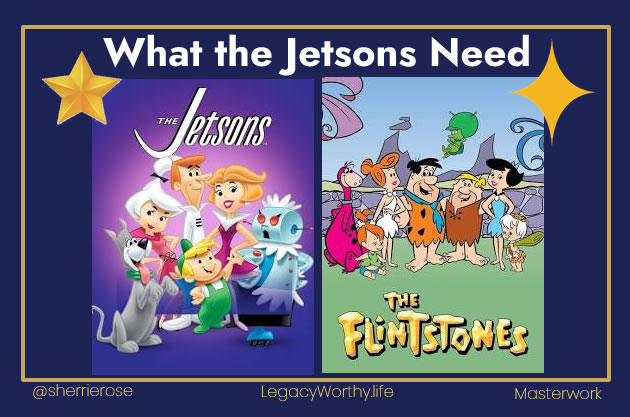
The Flintstones premiered on September 30, 1960. The setting is Bedrock, a prehistoric town stocked with modern conveniences. Fred and Wilma Flintstone raise their daughter Pebbles next door to their best friends, Barney and Betty Rubble. The jokes come from translating everyday life into Stone Age terms: a bird serves as a record player needle, a mammoth works as a vacuum cleaner, and a dinosaur handles the heavy lifting at the quarry.
The Jetsons premiered on September 23, 1962. The setting is Orbit City, a 21st-century suburb built on platforms high above the ground. George and Jane Jetson live with their teenage daughter Judy and their young son Elroy, along with Astro the dog and Rosie the robot maid. The jokes come from automation: moving sidewalks, flying cars, and a workday that consists of pressing a button a few times and feeling exhausted anyway.
Side by Side
The two shows share a structure and diverge in their details.
Humor. The Flintstones finds comedy in the past by dressing familiar modern life in prehistoric props. The Jetsons finds comedy in the future by showing that technology removes chores while leaving every human worry in place.
Tone. The Flintstones draws on the working-class sitcom tradition and borrows heavily from The Honeymooners, with Fred as the loud, scheming provider. The Jetsons plays as a middle-class suburban comedy, with a recurring anxiety about machines, job security, and a demanding boss.
Length. The Flintstones ran for about 166 episodes across six seasons. The Jetsons produced 24 episodes in its original single season.
Revival. The Jetsons returned in 1985 with 51 new episodes and reached the big screen in a 1990 film. The Flintstones spun off into many specials and series over the decades.
The Theme Songs
Both shows opened with music from composer Hoyt Curtin, who wrote much of Hanna-Barbera’s output. “Meet the Flintstones” is a brassy, swinging tune that welcomes viewers into a modern Stone Age household and promises a good time. It lived on well beyond the original series, and the B-52s recorded a new version for the 1994 live-action film.
The Jetsons theme has a breezy, jazzy, space-age sound. It introduces the family one member at a time, in order from George to Jane to Judy to Elroy. The melody reflects the optimism of an era that expected a bright, convenient future.
Popularity
The Flintstones was the larger hit in its own time. It was the first animated series to air in primetime, it drew big audiences, and it held the record as the longest-running primetime animated series until The Simpsons passed it in the late 1990s. It also became a merchandising powerhouse, with Flintstones vitamins, branded cereals, theme parks, and two live-action films.
The Jetsons had a modest first run and ended after one season. Its audience grew later, through Saturday morning reruns and syndication, and the 1985 revival cemented it for a new generation of children. Today the show serves as shorthand for the future as people imagined it in the early 1960s. Writers and commentators often point to it when a new technology, such as video calling, robot vacuums, or smart home devices, resembles something the show depicted.
Who Remembers Both Worlds?
Boomers and Gen X know both cartoon timelines firsthand. Boomers met The Flintstones as new primetime television. Gen X watched both families on Saturday mornings in reruns, and The Jetsons returned with new episodes while many of them were still in school. Both generations grew up with rotary phones, vinyl records, film cameras, and handwritten letters, then lived through the arrival of email, smartphones, and video calls. That makes them the last analog generation.
| Timeline | Show | The call | What it stands for |
|---|---|---|---|
|
Yesterday |
The Flintstones |
Champion Yesterday |
The analog world: photographs, letters, records, and the stories behind them |
|
Today |
Boomers and Gen X |
Create Today |
The generation that remembers both worlds, with decades of worthy experience |
|
Tomorrow |
The Jetsons |
Transform Tomorrow |
The digital and AI era, where video calls and robot helpers now feel familiar |
The Flintstones stands in for yesterday, a world of handmade and hand-dialed things that now lives in archives. The Jetsons stands in for tomorrow, and much of it has arrived. Boomers and Gen X live in the middle, where experience points in two directions at once.
Why Does Experience Look Two Ways?
Looking back, experience is an archive: the stories, lessons, relationships, and achievements gathered across decades. Looking ahead, experience gains a purpose when it benefits the people living in the Jetsons future. The archive explains where a life has been. The future gives that archive a reader.
Which Day Belongs to You?
Champion Yesterday. The Flintstones decades supplied the material: photographs, letters, records, and well-earned lessons from an analog life. Championing yesterday means giving those stories their due while the people who lived them can still tell them.
Create Today. Today is the one day you can act on. Your wisdom is active now, and you decide, on your own terms, what your decades of experience will mean for other people.
Transform Tomorrow. The Jetsons future arrived, and the people living in it still worry about the boss, the bills, and the kids. Your experience gives them a head start no device can supply.
Where Masterwork Fits
Masterwork gives the archive a direction. In the Masterwork Years, accomplished people develop their masterwork from decades of worthy experience, sharing value for generations. Masterwork becomes legacy, a dynamic living legacy developed while wisdom is active and on their own terms.
The two cartoon families frame the opportunity. The Flintstones era supplies the material: a past preserved in memory, boxes, and files. The Jetsons era supplies the audience: younger generations living in a future this generation helped create. Masterwork360 is a guided development path for accomplished people in their Masterwork Years who want their decades of wisdom to benefit other people.
Consider the shoebox in the hall closet, full of photographs from the analog decades. A few have names and dates penciled on the back, and most do not. Each year, fewer people recognize the faces, and the stories behind them fade.
Wisdom has a half-life. Masterwork makes it whole.™
Champion Yesterday. Create Today. Transform Tomorrow.