
The Ticket That Took You Around the World: From Paper to Pixels
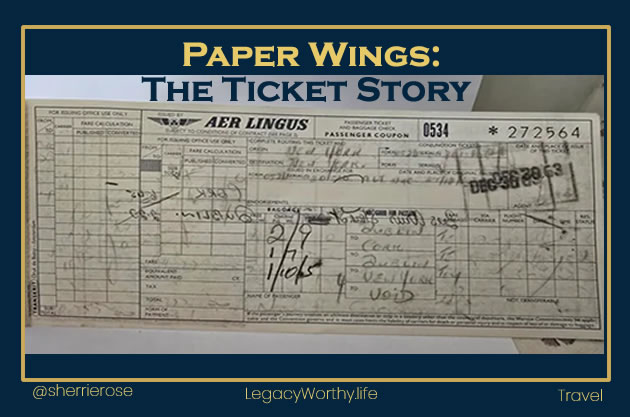
The Ticket That Took You Around the World: From Paper to Pixels.
There was a time when getting on an airplane required considerably more than showing up with a phone.
You needed a ticket.
Not a confirmation email. Not a QR code. Not an airline app.
A real ticket.
It could be a small booklet of carefully printed paper, filled with coupons, carbon copies, codes, fare information, routing instructions and conditions of carriage. If your trip involved several flights, there could be a separate coupon for every segment. If you were flying on more than one airline, the ticket had to work across different companies.
And before airport security became what we know today, getting onto the airplane was remarkably different, too.
The history of the airline ticket is really the history of how air travel became organized, standardized and eventually computerized.
In the Beginning, Flying Was Simple
Commercial aviation in the 1920s was nothing like today’s airline industry.
Passenger service was limited, aircraft were small, schedules were sparse, and there were far fewer choices. In some early operations, there might effectively be one aircraft, one route and one available passenger seat.
As aircraft became larger and airlines began carrying more passengers, the problem changed.
Airlines now had to keep track of who was flying, where they were going, how much they had paid, which flight they were taking and whether there would be a seat available when they arrived.
The ticket became the physical record that held all of this together.
By the 1930s, booking a flight could involve a surprisingly manual process. American Airlines, for example, used what was essentially a “request and reply” system. A travel agent contacted an airline sales agent, who contacted the airline’s inventory operation to determine whether a seat was available. The answer could come back by telephone or teletype.
There was no website displaying 37 available flights.
There was no app.
There wasn’t even a computerized reservation system.
Someone had to find the seat.
Why Travel Agents Became So Important
The travel agent was once much more than someone who recommended hotels.
The agent was part researcher, part reservation specialist, part accountant and part ticketing department.
Airlines published schedules and fares, but finding the right combination of flights could be complicated. A traveler going from Los Angeles to Paris might not simply purchase one flight. The trip could involve several airlines, connections, stopovers and different fare rules.
The travel agent handled the complexity.
The agent could contact airlines, request reservations, calculate fares, issue the ticket and assemble the passenger’s itinerary.
This became particularly important as international air travel expanded.
In 1945, the International Air Transport Association (IATA) was created, and the industry began developing common standards for fares, ticketing, baggage, agency relationships and interline travel. By 1947, IATA’s first worldwide Traffic Conference had established rules covering matters such as fare construction, revenue sharing, ticket design and travel-agency procedures.
That standardization solved a fundamental problem:
How can one ticket represent a journey involving several airlines?
The answer was interlining.
A passenger could purchase a single ticket and travel on multiple airlines. The airlines then settled the money between themselves according to standardized rules.
That sounds ordinary today.
At the time, it was a remarkable piece of coordination.
The Airline Ticket Wasn’t Really One Ticket
This is where the old airline ticket becomes fascinating.
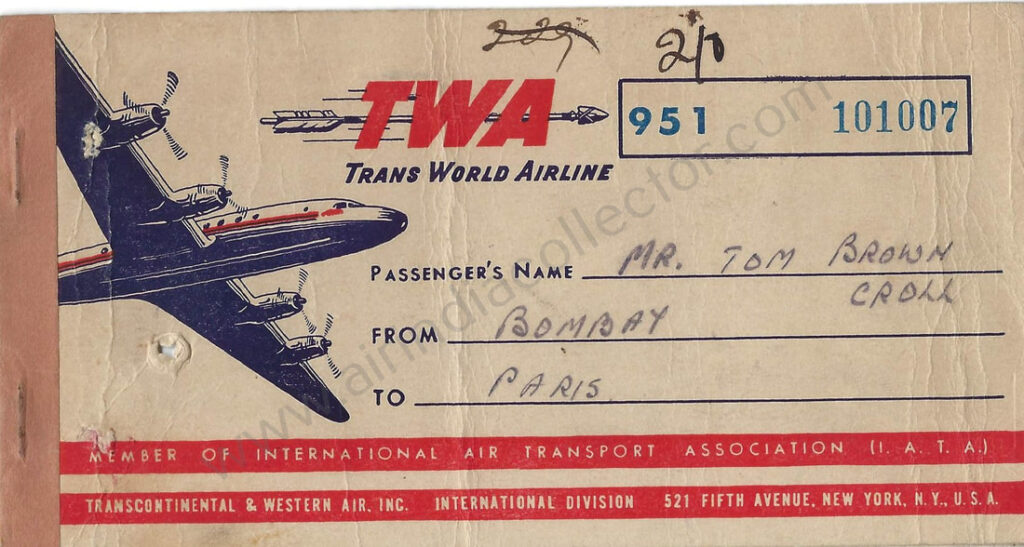
What people called “the ticket” was often a booklet or packet of paper containing multiple components.
For a multi-flight itinerary, there could be an individual flight coupon for each segment of the trip.
Think of the ticket as a little paper accounting system.
If you were flying:
New York → Chicago → Los Angeles → Honolulu
you could have separate coupons corresponding to the individual portions of the journey.
Each coupon represented a particular piece of transportation.
The airline operating that segment would take control of the appropriate coupon when you traveled. The used coupon became part of the accounting trail between the airlines.
The U.S. Bureau of Transportation Statistics still uses the term “coupon” in its airline data systems. A coupon represents the passenger’s actual boarding and deplaning points for a particular portion of an itinerary.
The paper ticket therefore wasn’t just a receipt.
It was a physical token of transportation entitlement.
And There Was More Than One Copy
The paper system also depended on duplication.
Tickets were commonly produced using multi-part forms and carbon paper. Information entered on one layer could be transferred to the copies underneath.
There might be:
- the passenger’s copy
- airline or agent copies
- flight coupons
- an agent’s accounting record
- supporting documents and notices
- baggage documentation
The precise configuration changed over the decades and between systems, but the principle remained the same: multiple parties needed a record of the transaction.
The passenger needed proof of purchase.
The airline needed proof of the transportation sold.
The agent needed a record of the transaction.
And when multiple airlines were involved, the carriers needed documentation for settlement.
The physical paper moved through the system as the passenger moved through the journey.
What Did an Airline Ticket Look Like?
Old airline tickets were surprisingly elaborate.
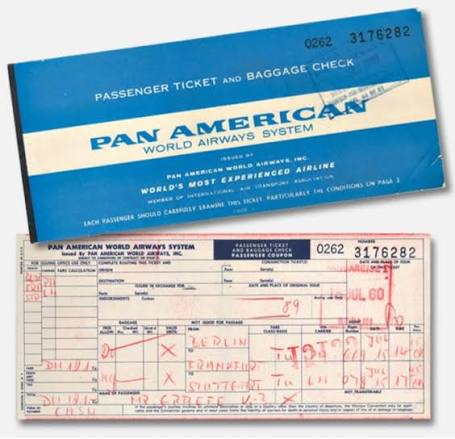
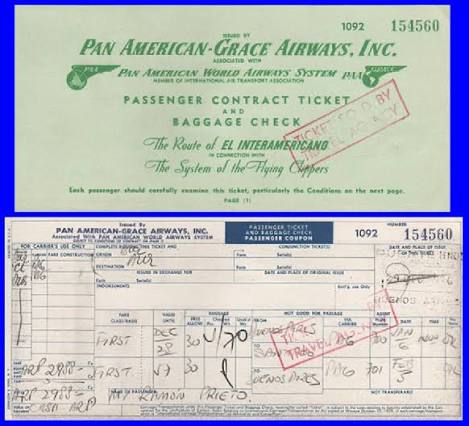
A typical ticket booklet could contain the passenger’s name, issuing airline, origin and destination, flight information, fare, ticket number, routing, restrictions and conditions of carriage.
The individual coupons were carefully formatted.
They were often printed in different colors or on distinctive paper stocks, with portions designed to be removed, retained or processed by different people.
Some tickets were handwritten or typed. Others were produced with specialized ticketing machines.
The ticket itself could be small enough to fit into a pocket, but it represented a substantial amount of information.
It also had another important characteristic:
It was tangible.
Lose it, and you could have a problem.
That was one of the great vulnerabilities of the paper-ticket era.
The Itinerary Was Something Different
The ticket and the itinerary were related, but they were not exactly the same thing.
The ticket represented the passenger’s right to transportation and the financial transaction behind it.
The itinerary told the passenger what the trip was supposed to look like.
An itinerary might list:
Flight 123
New York → London
Departure: 7:30 PM
Arrival: 7:10 AM
Then the connecting flight:
Flight 456
London → Paris
Departure: 10:15 AM
Arrival: 12:30 PM
The itinerary was the traveler’s roadmap.
The ticket was the document that made the transportation possible.
In the paper era, the two were often physically bundled together.
There Was No “Check-In” Quite Like Today
Today’s airport experience makes it easy to forget how much of the process developed later.
For much of commercial aviation’s history, there was no TSA checkpoint standing between the public and the departure gate.
You could arrive at the airport, go to the airline’s ticket counter or even, in some circumstances, the gate, deal with the airline representative, receive your boarding documentation and proceed toward the aircraft.
In earlier decades, the airport gate was not a highly restricted zone in the way it is today.
The dramatic change came largely from the rise of aircraft hijackings in the late 1960s and early 1970s.
In the United States, the FAA issued an emergency rule requiring airlines beginning January 5, 1973, to inspect carry-on baggage and screen passengers with metal detectors or, where necessary, physical searches. By February 5, screening had become universal at the nation’s air carrier airports rather than being limited to passengers who fit a particular hijacking profile.
That fundamentally changed the airport.
Before security:
Terminal → Gate → Airplane
After security:
Terminal → Security → Sterile area → Gate → Airplane
The boarding pass became increasingly important because it became the document that connected the passenger to the controlled boarding process.
The Boarding Pass Was Not the Ticket
This distinction is often lost today.
The ticket said, essentially:
“You have purchased transportation.”
The boarding pass said:
“You have checked in for this particular flight and are authorized to board.”
The two documents served different purposes.
For years, travelers could have both in hand.
The ticket might be a little booklet containing several flight coupons. The boarding pass could be a separate card or paper document with the flight number, date, destination and seat assignment.
At the gate, an airline employee could inspect the documents, take or mark the appropriate coupon and allow the passenger to board.
The entire system was designed around physical handoffs.
The Computer Changes Everything
The next revolution wasn’t the Internet.
It was the computer.
Airlines began developing computerized reservation systems in the 1960s.
One of the landmark systems was SABRE, developed by American Airlines and IBM. It changed the airline reservation process from a largely manual system into a computerized one.
Now the airline could maintain an electronic record of reservations and seat inventory.
That distinction is critical.
The computer didn’t initially eliminate the paper ticket.
It eliminated the need for the reservation itself to exist only on paper or in someone’s memory.
The reservation became digital first.
The ticket remained physical.
For decades, these two worlds existed side by side.
The Travel Agent Enters the Computer Age
Computerized reservation systems eventually transformed travel agencies as well.
Instead of telephoning an airline and waiting for someone to check inventory, agents could access reservation systems directly.
This was the beginning of what became known as the Global Distribution System, or GDS.
Travel agents could see schedules, availability and fares from multiple airlines and construct complicated itineraries.
For the traveler, the experience still looked wonderfully simple:
“Here’s your ticket.”
Behind that piece of paper, however, was an increasingly sophisticated computer network.
The travel agent was becoming the human interface to the airline industry’s emerging digital infrastructure.
The Ticketless Experiment
Some airlines began experimenting with a radically different idea:
What if there were no ticket?
Southwest Airlines was an early pioneer.
In January 1995, Southwest introduced coast-to-coast ticketless travel, allowing customers to travel using a confirmation number rather than a traditional paper ticket. The airline’s system could locate the reservation using the passenger’s information, and the traveler could receive a boarding pass at the airport.
This was an important conceptual shift.
The passenger no longer needed to carry the thing that proved the reservation existed.
The airline’s computer already knew.
The E-Ticket Arrives
Electronic ticketing began appearing in the 1990s. The first electronic tickets were introduced around 1994, and adoption accelerated rapidly as airlines recognized how much money and administrative work could be eliminated by removing paper from the process.
The basic idea was revolutionary in its simplicity:
The ticket does not have to be a piece of paper.
It can be a record in a computer system.
The passenger could receive an itinerary receipt showing the details of the transaction, but the physical paper itself was no longer the thing that carried the value.
That distinction solved one of the biggest problems of the old system.
You could no longer “lose your ticket” in quite the same way.
2008: The Paper Ticket Effectively Dies
The final step came quickly.
IATA launched its “Simplifying the Business” program in 2004, with the goal of replacing paper ticketing with electronic ticketing.
At the beginning of the initiative, only about 19 percent of tickets issued globally were electronic.
By the end of 2007, that figure had reached 92 percent.
On June 1, 2008, IATA achieved 100 percent electronic ticketing for its member airlines’ transactions through its Billing and Settlement Plan.
The industry had effectively retired the paper airline ticket.
IATA estimated that eliminating paper tickets would save the airline industry approximately $3 billion annually.
That was the end of an era.
No more little booklets.
No more flight coupons being torn from a ticket.
No more worrying that the most important piece of paper in your vacation had disappeared into your suitcase.
Then the Boarding Pass Went Digital
The ticket had disappeared.
The boarding pass was next.
IATA’s paperless-travel program moved toward bar-coded boarding passes, allowing passengers to check in online and display the boarding credential electronically.
Eventually, the boarding pass moved onto the device that was already in your pocket.
Your phone.
Today, you might never receive a physical airline ticket at all.
You book a flight online.
The airline creates a reservation.
The reservation receives a record locator.
Payment creates an electronic ticket record.
The itinerary appears in your email or airline app.
You check in online.
The airline generates a boarding pass.
A barcode or QR-style code represents the information.
At security, the boarding credential is scanned.
At the gate, it is scanned again.
And you board.
The paper has disappeared.
The information has not.
What You Have Today Is Really a Stack of Digital Records
The modern airline journey can feel as if the ticket has vanished.
In reality, it has simply become invisible.
There is still a reservation.
There is still a ticket number.
There are still flight segments.
There are still fare rules.
There are still records of payment and changes.
There is still an itinerary.
There is still a boarding credential.
There are still systems tracking whether each segment has been used.
The difference is that these things no longer have to travel around with you in your pocket.
The computer carries them.
Delta, for example, describes electronic ticketing as a system in which the historical record of the ticket transaction is maintained electronically, while the passenger receives an electronic ticket or itinerary receipt.
The old ticket was a physical object representing a digital relationship that did not yet have the technology to exist digitally.
The modern ticket is a digital record that may be represented by nothing more than a screen.
And the Travel Agent?
The travel agent didn’t disappear.
The role changed.
When air travel was primarily a manual information problem, the travel agent’s value was access.
The agent knew the schedules.
The agent knew the fares.
The agent could make reservations.
The agent could issue tickets.
The agent knew how to construct complicated itineraries.
The Internet changed the value equation because travelers gained direct access to airline schedules, fares and reservations.
The travel agent no longer had a monopoly on information.
But complexity never disappeared.
Today, travel advisors can still be particularly valuable for complicated international itineraries, groups, corporate travel, cruises, luxury trips and situations where something goes wrong.
The modern agent is less likely to be the person who merely “gets you a ticket.”
The role is increasingly about orchestrating travel.
IATA still supports a global network of accredited travel agents, with more than 54,000 IATA-accredited agencies worldwide.
What exactly was that little piece of paper doing behind the scenes?
Paper → Coupons → Travel Agent → Boarding Pass → Computer → E-Ticket → Phone
Before computers could instantly share information, the ticket carried the information that made the entire journey possible.
It was doing several jobs at once:
- It proved you had purchased transportation
The ticket was your contract with the airline.
It showed:
- who was traveling
- where they were going
- which airline was responsible
- how much had been paid
- what rules applied to the trip
Without it, there was no easy way for the airline to verify that you had a valid reservation and a paid fare.
- It mapped your journey
A ticket was not just for one flight.
A multi-stop trip might contain multiple flight coupons, each representing a specific segment:
New York → London
London → Paris
Paris → Rome
Each coupon represented a piece of transportation that had been purchased.
The ticket was essentially a paper itinerary before the word “itinerary” became a digital document.
- It told airlines who owed whom money
This was one of its most important hidden functions.
If you flew on multiple airlines, the first airline that issued your ticket might collect the entire fare.
But another airline might actually operate part of your journey.
The paper coupons created a record of that transaction.
When the flight coupon was collected, it became evidence that:
- the passenger traveled
- the airline provided the service
- revenue needed to be shared
The ticket was part passenger document, part accounting record.
- It guided airline employees through the journey
At each stage, different people interacted with the ticket:
- Travel agent: created and issued it
- Airline ticket agent: verified and processed it
- Gate agent: collected the correct flight coupon
- Airline accounting departments: used it for settlement
The ticket physically moved through the system as the passenger moved through the journey.
- It connected a human traveler to a massive system
Today, a database handles this instantly.
In the paper era, the ticket was the bridge between a person and a worldwide transportation network.
That small booklet contained the information needed to move one person across thousands of miles, often across several companies, countries, currencies, and legal systems.
The airline ticket was not just a receipt.
It was a portable database before databases were portable.
A few ounces of paper carried the instructions, permissions, financial records, and proof needed to make global air travel work.
From Ticket to Itinerary to Identity
There is an even larger story here.
The airline ticket has gone through three major stages.
- The Ticket as an Object
You possessed a physical document.
Lose it, and you could have a serious problem.
- The Ticket as a Record
The reservation and ticket moved into computer systems.
The passenger could carry an itinerary receipt rather than the actual transportation record.
- The Ticket as an Experience
Today, much of the process is invisible.
Your reservation exists in airline systems.
Your ticket exists as an electronic record.
Your itinerary exists in an app or email.
Your boarding pass appears on your phone.
Your identity and travel information are connected to the reservation.
The physical ticket has almost completely disappeared.
What We Gained
The modern system is dramatically more convenient.
You can book from almost anywhere.
You can change flights without physically returning to a travel agency.
You can reprint an itinerary instantly.
Your airline can locate your reservation even if you lose the piece of paper that would once have been your ticket.
Last-minute changes can be processed electronically.
Connections between airlines can be managed through interconnected systems.
And millions of passengers can be processed without moving millions of pieces of paper.
What We Lost
Something disappeared along with the paper.
The old ticket was a physical artifact of a journey.
It had a weight.
It had stamps, marks, handwriting, carbon impressions and little pieces that had been removed at different stages of the trip.
It told the story of where you had been.
Today, your airline ticket may be nothing more than a line in a database.
Your itinerary may be an email.
Your boarding pass may disappear from your phone the moment the flight is over.
The system is vastly more efficient.
But the artifact is gone.
The Strange Fate of the Airline Ticket
The airline ticket began as a solution to a very physical problem:
How do we prove that this person has paid for this particular journey?
As aviation expanded, the ticket became more sophisticated.
It became a booklet.
Then a collection of coupons.
Then a standardized industry document.
Then a computer record accompanied by a printed itinerary.
Then an electronic ticket.
Then a barcode.
And finally, for many travelers, it became something you never really see at all.
The journey remains.
The ticket has become invisible.
That may be the most interesting part of the story.
The old airline ticket was a physical object carrying information between people and organizations.
The modern airline ticket is information moving invisibly between systems.
We haven’t eliminated the ticket.
We have eliminated the paper that used to prove it existed.