
Why Tech Giants Collapse After Years of Dominance
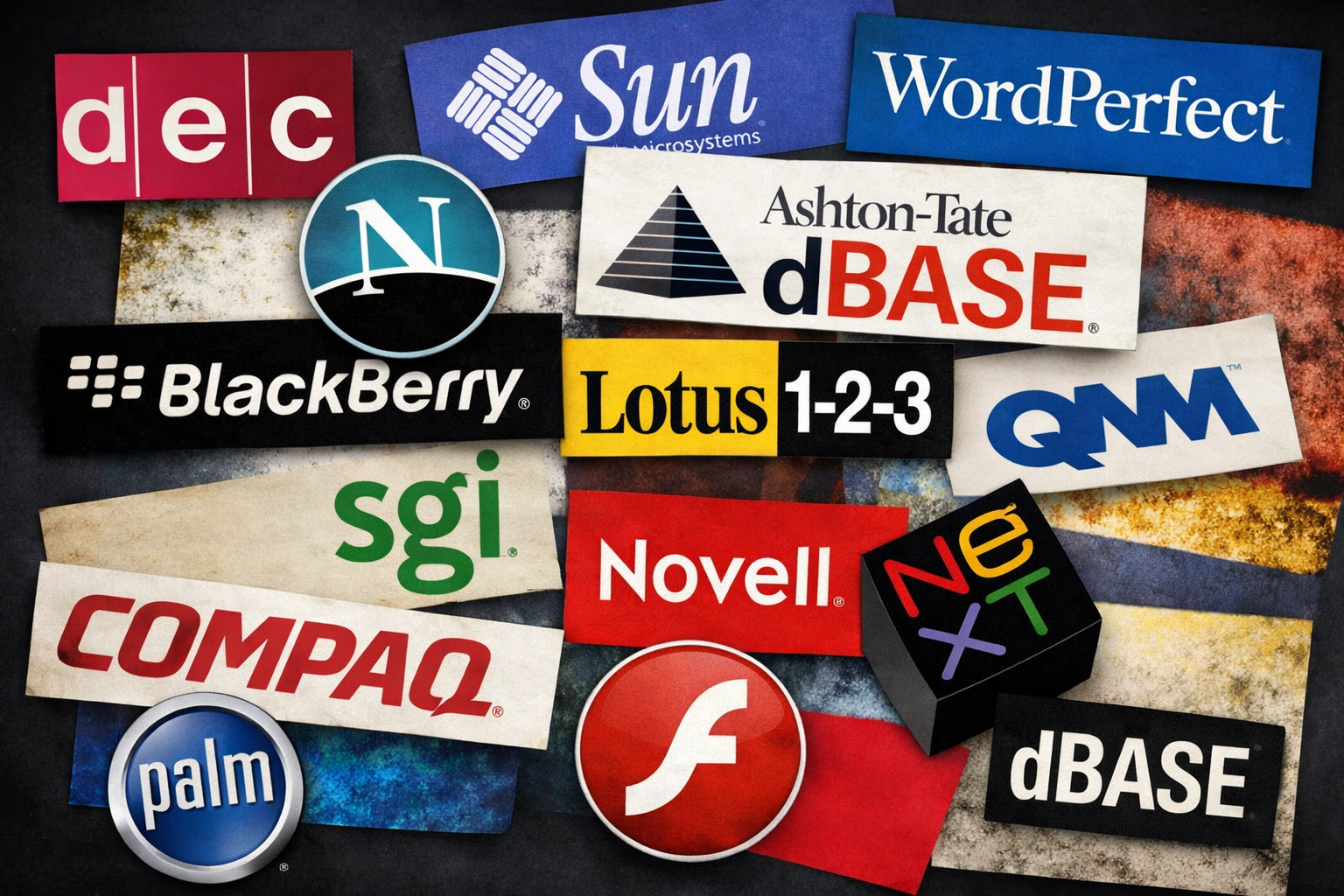
Why Tech Giants Collapse After Years of Dominance
For decades, tech giants have appeared untouchable. They dominated markets, defined standards, and built ecosystems that seemed permanent. Their products became infrastructure. Their brands became synonymous with innovation. Yet history shows a recurring pattern: collapse follows dominance.
The failure rarely begins with incompetence. It begins with a platform shift.
When the foundational layer of technology changes, from minicomputers to personal computers, from DOS to Windows, from proprietary UNIX systems to Linux, and from the desktop web to mobile ecosystems, power migrates. Companies that once controlled distribution begin to depend on someone else’s platform. Their leverage erodes. Their margins compress. Their influence weakens.
This is the structural rule of technology: control the platform or become exposed to it.
Digital infrastructure rewards those who own the base layer, such as the operating system, network standard, or ecosystem gateway. Companies that operate above the platform can remain successful for years. Sometimes for decades. But when architecture shifts, even market leaders can collapse with surprising speed.
The lesson is not management failure. It is platform power, distribution control, and architectural leverage.
In technology, dominance is durable until the platform moves.
The most powerful companies in technology collapse after years — sometimes decades — of dominance. Their products define markets. Their standards shape industries. Their influence appears durable, even permanent.
Then the foundation beneath them shifts. It is structural displacement not gradual decline.
Again and again, tech giants collapse after long periods of strength because the platform layer they depend on moves — and control shifts with it. Many of them build technologies that remain legacy worthy long after corporate control fades.
Technology history is often told as a sequence of breakthroughs and failures.
But a closer look reveals a more unsettling pattern.
I. TECH GIANT: Minicomputer Era → Personal Computer Shift
Digital Equipment Corporation (DEC)
Founded in 1957, Digital Equipment Corporation dominated the minicomputer market. Its VAX systems became deeply embedded in universities, scientific research institutions, and enterprise environments. For years, DEC was second only to IBM in computing influence.
Its dominance lasted long enough to feel institutional. Engineers built careers around its systems. Organizations standardized on its architecture. The company appeared structurally secure.
But computing economics changed.
As personal computers grew more powerful and commodity servers became affordable, centralized minicomputers lost their economic advantage. The platform layer shifted from proprietary systems to distributed, lower-cost architectures.
In 1998, DEC was acquired by Compaq for 9.6 billion dollars.
The collapse did not reflect inferior engineering. It reflected a platform transition that undermined the layer DEC controlled.

II. TECH GIANT: DOS Software Era → Windows Shift
Ashton-Tate
Ashton-Tate’s dBASE was one of the earliest dominant database programs for IBM PCs. During the early PC era, it became foundational business software.
For years, dBASE was embedded in small business operations across industries. Its position appeared durable.
But the operating system layer shifted. Microsoft expanded Windows and bundled integrated tools into its ecosystem. Competitors modernized faster. Platform leverage moved upward.
In 1991, Ashton-Tate was acquired by Borland. The brand soon disappeared.
Dominance built on one platform rarely survives when that platform loses control.

Lotus Development Corporation
Lotus 1-2-3 defined spreadsheet computing in the 1980s. It was essential corporate software and a primary driver of PC adoption in business.
Its dominance lasted long enough to seem permanent. Entire workflows depended on it. Financial modeling culture grew around it.
Then the shift from DOS to Windows rewrote the competitive map. Microsoft Excel, optimized for Windows and bundled into Microsoft Office, gained structural distribution advantage.
In 1995, Lotus was acquired by IBM for 3.5 billion dollars.
Years of dominance unraveled as the operating system layer consolidated power.

WordPerfect Corporation
WordPerfect dominated word processing in the DOS era, especially in legal and government sectors where formatting precision was critical.
Its user base was loyal. Its market share was commanding. Its formatting precision made it deeply trusted. In many professional settings, it was treated as legacy worthy documentation infrastructure.
But when Windows became the primary computing interface, Microsoft Word benefited from integration and bundling within the broader Office ecosystem. WordPerfect’s Windows transition lagged.
Acquired by Novell in 1994 and later sold to Corel in 1996, WordPerfect never regained mainstream leadership.
Dominance at the application layer proved vulnerable once the operating system layer consolidated distribution.
III. TECH GIANT: Network Operating System Era → Windows Server Shift
Novell
Novell’s NetWare system powered local area networks throughout the 1980s and early 1990s. It was considered the backbone of enterprise networking.
For years, its control over the network layer appeared secure. IT departments standardized around it. Certifications and training reinforced its ecosystem. It was considered legacy worthy enterprise infrastructure because of its reliability and installed base.
Then Microsoft integrated networking directly into Windows NT Server. Instead of competing above the operating system, Novell faced competition from the operating system itself.
Businesses increasingly standardized on Windows environments.
In 2010, Novell was acquired by The Attachmate Group for 2.2 billion dollars.
The collapse followed years of dominance — undone not by failure to execute, but by a platform vendor absorbing its layer.
IV. TECH GIANT: Proprietary UNIX Workstations → Linux and x86 Commoditization
Sun Microsystems
Sun Microsystems built powerful UNIX workstations and servers. It created Solaris and the Java programming language. Java remains one of the most legacy worthy programming platforms in global software development.For years, Sun powered much of the early internet infrastructure.
Its systems were embedded in enterprises and startups alike. Its dominance felt deeply technical and durable.
But after the dot-com crash, demand shifted toward lower-cost Linux systems running on commodity x86 hardware. Performance became good enough. Economics became decisive.
The proprietary hardware layer weakened.
In 2010, Sun was acquired by Oracle for 7.4 billion dollars.
Its technologies endured. Its corporate independence did not.
Note: The original Sun Microsystems sign was preserved behind the Facebook/Meta company sign. It was meant to be a reminder to Facebook employees to stay motivated and innovative and to not become complacent.

Silicon Graphics (SGI)
Silicon Graphics produced advanced 3D graphics workstations used in film, engineering, and scientific visualization.
For years, its machines represented the pinnacle of visual computing. Its technology influenced modern graphics computing and remains legacy worthy in engineering history.
But as GPUs became standardized and affordable in mainstream PCs, specialized workstations lost their economic advantage. The platform for graphics computing commoditized.
In 2009, SGI filed for bankruptcy. Its assets were sold.
Technical excellence could not offset structural cost compression.
NeXT
Founded by Steve Jobs, NeXT built advanced workstations and developed the NeXTSTEP operating system.
The hardware struggled commercially due to price. But its operating system architecture proved foundational. While the hardware failed commercially, the software architecture was highly legacy worthy.
In 1997, Apple acquired NeXT for 429 million dollars.
NeXT’s hardware dominance never materialized — but its software platform became the foundation for macOS and later iOS.
In rare cases, collapse at one layer seeds dominance at another.
V. TECH GIANT: Web Browser and Multimedia Platform Era
Netscape
Netscape Navigator dominated early web browsing and accelerated internet adoption.
Its market share was overwhelming. For a moment, it appeared to control the gateway to the web. Its role in early web history is considered legacy worthy because it shaped browser design conventions.
But Microsoft bundled Internet Explorer into Windows at no additional cost. Distribution shifted to the operating system layer.
In 1999, Netscape was acquired by AOL for 4.2 billion dollars.
Its open-source legacy contributed to Mozilla and Firefox. Its dominance collapsed once the browser became subordinate to the OS platform.
Macromedia
Macromedia created Flash, Dreamweaver, Director, FreeHand, and Fireworks.
Flash became the standard platform for web animation and video. For years, Flash was the legacy worthy standard for interactive web animation. Dreamweaver defined web development workflows. For years, Macromedia controlled the rich media layer of the internet.
Then smartphones reshaped computing behavior. The iPhone rejected Flash. Open web standards like HTML5 replaced plugin-based platforms.
In 2005, Macromedia was acquired by Adobe for 3.4 billion dollars.
Flash was discontinued in 2020.
Years of dominance evaporated as the web platform reorganized around mobile ecosystems.

VI. PC Hardware Consolidation
Compaq
Compaq became one of the largest manufacturers of IBM-compatible PCs. It expanded into enterprise servers and acquired DEC.
Its growth was aggressive and sustained. For years, it appeared to be building a lasting hardware empire. Its hardware architecture influenced early enterprise PC deployment and remains legacy worthy in PC industry history.
But PC manufacturing commoditized. Margins shrank. Consolidation followed.
In 2002, Hewlett-Packard acquired Compaq for 25 billion dollars.
Dominance in commoditized layers rarely endures.
VII. Mobile Platform Shift
Palm, Inc.
Palm dominated personal digital assistants before smartphones. Its Palm Pilot devices were ubiquitous in business environments.
Its platform felt secure within mobile productivity. The WebOS platform is still studied as a technically advanced mobile architecture and is considered legacy worthy by some software historians.
But Apple and Google reshaped mobile computing around touchscreen ecosystems and app stores. The platform shifted from device-centric to ecosystem-centric.
In 2010, Hewlett-Packard acquired Palm. WebOS was later abandoned.
Years of dominance could not withstand a new mobile architecture.
BlackBerry
BlackBerry dominated secure enterprise smartphones in the early 2000s. Governments and corporations standardized around its devices.
Its market position was strong, loyal, and defensible — until the smartphone platform redefined user expectations. Its secure messaging architecture became legacy worthy in corporate and government environments.
Touchscreens and app ecosystems changed the center of gravity in mobile computing.
BlackBerry exited hardware and pivoted to enterprise software.
Dominance built over years collapsed within a single platform cycle.
The Structural Pattern
Viewed chronologically, these tech giant companies rose, dominated, and then collapsed.
Viewed structurally, a consistent pattern emerges.
Each company controlled a layer of the technology stack:
- Hardware
- Operating systems
- Network infrastructure
- Applications
- Web platforms
- Mobile ecosystems
Their dominance endured as long as that layer remained foundational.
But when the underlying platform shifted, leverage moved elsewhere.
Minicomputers gave way to personal computers.
DOS gave way to Windows.
Proprietary networking gave way to integrated server platforms.
UNIX workstations gave way to Linux on commodity hardware.
Desktop web plugins gave way to mobile ecosystems.
The companies above the shifting layer collapsed after years of dominance — not because they were incompetent, but because structural control changed.
The lesson is not about management failure.
It is about platform power.
In technology, dominance can last a decade or more.
Until the platform moves.
And when it does, even giants fall.
TECH GIANT: Sources
Digital Equipment Corporation (DEC)
https://en.wikipedia.org/wiki/Digital_Equipment_Corporation
https://en.wikipedia.org/wiki/VAX
Ashton-Tate
https://en.wikipedia.org/wiki/Ashton-Tate
https://en.wikipedia.org/wiki/DBase
Lotus Development Corporation
https://en.wikipedia.org/wiki/Lotus_Software
https://en.wikipedia.org/wiki/Lotus_1-2-3
https://en.wikipedia.org/wiki/Lotus_Notes
WordPerfect Corporation
https://en.wikipedia.org/wiki/WordPerfect
https://en.wikipedia.org/wiki/WordPerfect_Corporation
Novell
https://en.wikipedia.org/wiki/Novell
https://en.wikipedia.org/wiki/NetWare
Sun Microsystems
https://en.wikipedia.org/wiki/Sun_Microsystems
https://en.wikipedia.org/wiki/Solaris_ (operating_system)
https://en.wikipedia.org/wiki/Java_ (programming_language)
Silicon Graphics (SGI)
https://en.wikipedia.org/wiki/Silicon_Graphics
NeXT
https://en.wikipedia.org/wiki/NeXT
https://en.wikipedia.org/wiki/NeXTSTEP
Netscape
https://en.wikipedia.org/wiki/Netscape
https://en.wikipedia.org/wiki/Netscape_Navigator
Macromedia
https://en.wikipedia.org/wiki/Macromedia
https://en.wikipedia.org/wiki/Adobe_Flash
https://en.wikipedia.org/wiki/Adobe_Dreamweaver
https://en.wikipedia.org/wiki/Adobe_Fireworks
https://en.wikipedia.org/wiki/Adobe_Director
Compaq
https://en.wikipedia.org/wiki/Compaq
Palm
https://en.wikipedia.org/wiki/Palm,_Inc.
https://en.wikipedia.org/wiki/WebOS
BlackBerry
https://en.wikipedia.org/wiki/BlackBerry
https://en.wikipedia.org/wiki/BlackBerry_Limited
Note: this article was written with assistance from Ai