What the Odyssey Asks of You Once the Hero’s Journey Is Over
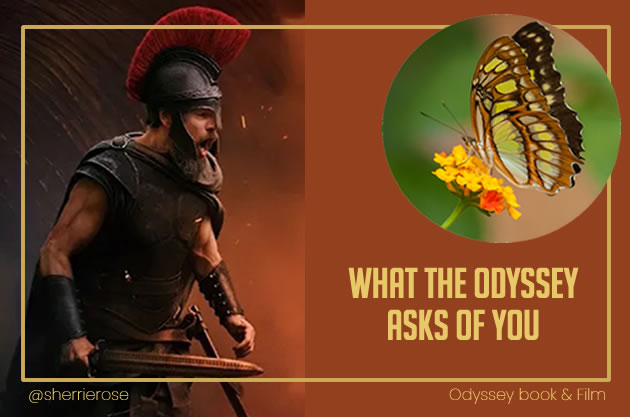
Ascent 2: After the Hero’s Journey Ends, the Odyssey Begins.
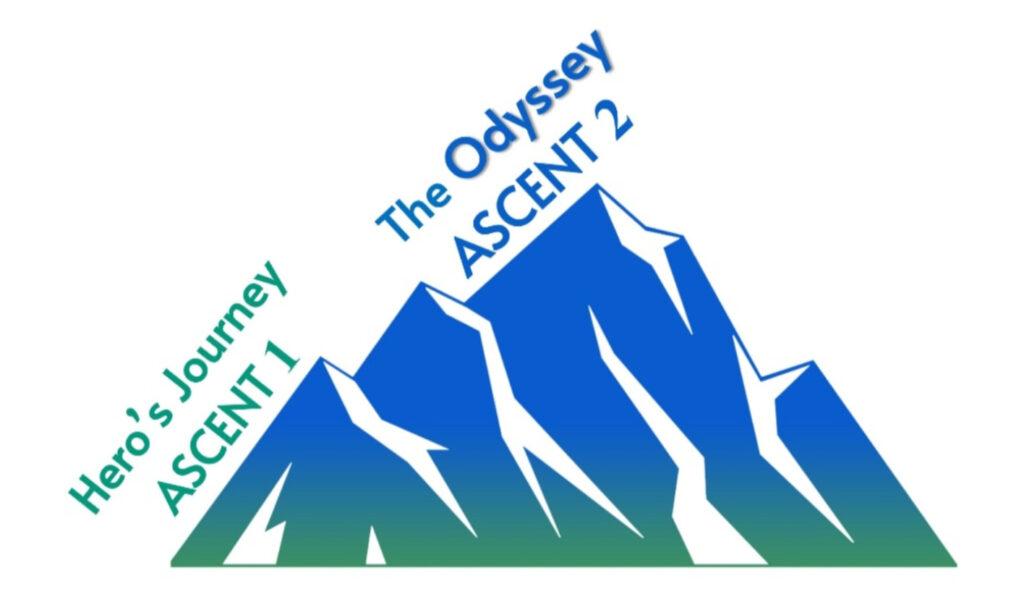
There’s a mountain graphic below that tells a story… before you climb it. The first peak is labeled Hero’s Journey, Ascent 1. Behind it, taller, sits a second peak: The Odyssey, Ascent 2.
Most people spend their lives on the first mountain. They face a challenge, they’re tested, they come home changed and a little wiser, and that’s the story they tell for the rest of their lives. It’s a good story. It’s also not the whole climb.
The Odyssey, Christopher Nolan’s three-hour epic starring Matt Damon as the Greek king, arrived in theaters in July 2026. The R-rated film pairs grand practical spectacle with psychological ambiguity, reinterpreting Homer’s myth through a grounded, trauma-informed lens. That lens is exactly what makes it a story about the second mountain rather than the first.
The Second Summit Has No Map
In The Cocoon Conundrum, Sherrie Rose describes what happens after you’ve already reached the first summit and can see farther than you could before. You notice the next mountain. You start to ask what you’d do now, with a wider view and no illusions left about how hard the terrain gets.
Not everyone takes this second climb. It isn’t required, and it isn’t glamorous. Homer’s Odyssey, unlike the more familiar hero’s-journey template, was never well mapped by mythologists into a clean set of stages. There’s no gear list for it. You go on faith, older than you were the first time, with less stamina and a body that has started sending you warnings it didn’t used to send. And somewhere in the last several years, most of us also watched a pandemic prove that health and youth are not the same thing as safety.
That combination, an aging body and an undeniable proof of mortality, tends to surface a fear people spend a lifetime managing without naming: the fear of death itself. Alan Watts called us “Gods in Disguise.” If that’s true, the terror of dying is a strange thing to carry underneath so much divinity. Most people resolve the tension the same way. They don’t resolve it. They avoid it, filling the space with achievement, activity, and motion so the question never has to be answered directly.
That avoidance is the real reason the second ascent has no map. It isn’t that the mountain is unclimbed. It’s that most people turn around before they get near it.
Homer’s Odysseus Climbs the First Mountain
Homer’s version of the myth belongs on Ascent 1. Every obstacle Odysseus meets, the Cyclops, the Sirens, Circe, Scylla and Charybdis, is a test that comes from outside him. The sea throws things at him. Gods interfere. He survives through cunning and endurance, and when he finally reaches Ithaca, he’s a wiser version of the man who left. That’s the hero’s journey in its purest form: the world tests you, and you come home changed for the better.
It’s a true story. It’s also a story about surviving your circumstances, not about facing what’s inside you.
Nolan’s Odysseus Climbs the Second Mountain
Nolan’s film points somewhere else entirely. In his version, the monsters stop being the real danger. Memory becomes the danger. Guilt becomes the danger. The Trojan Horse, celebrated for three thousand years as brilliance, becomes something Odysseus has to live with rather than something he gets to be proud of. Nolan reframes it as a violation of xenia, the ancient law of hospitality, and traces the consequences of that violation through every stop on the voyage home (Historically, hospitality towards foreigners and guests was understood as a moral obligation, as well as a political imperative). Odysseus returns from Troy carrying what plays on screen as untreated trauma from the killing he did and ordered, and confesses that guilt to Penelope before she even knows the beggar in her hall is her husband.
The film ending confirms just how far this reading goes. Odysseus does reclaim his home and does kill the suitors who threatened his family, the way Homer’s version does. But overwhelmed by war guilt and the violence of what he’s just done, he refuses to take back the crown. He hands Ithaca to Telemachus and sails west into exile with Penelope, who joins him not as a queen but as his partner in redemption, choosing to spend what’s left of their lives honoring what the war cost rather than ruling over what it won.
This is Ascent 2, rendered in trauma-informed detail on screen. It’s the climb Sherrie Rose describes as available only to those who’ve already summited once, gained the higher view, and can no longer pretend the second mountain isn’t there. Nolan’s Odysseus has already won the war. He’s already home safe by any external measure. What he hasn’t done is faced his own mortality, his own choices, or the fact that time is, as The Cocoon Conundrum puts it, a great leveler that comes for everyone regardless of what they accomplished on the way.
The Same Climb, Described Twice
Put the two versions side by side and a pattern appears. Ascent 1 asks you to survive what happens to you. Ascent 2 asks you to face what you’ve done, what you’ve avoided, and what you can no longer outrun.
Homer’s ending gives you a wiser man returning to his kingdom, still on the throne. Nolan’s ending gives you a man who wins his home back and then walks away from it, as an act of honesty (not defeat) about what he no longer believes he deserves to rule.
That’s the second summit. Not a bigger throne. A truer relationship with your own mortality, and the willingness to stop hiding behind achievement long enough to actually live in the time you have left.
The mountain graphic gets this exactly right by making Ascent 2 taller. It’s harder to see from a distance, and almost no one starts it by accident. You have to have already climbed once, gained the elevated view, and decided the higher summit is worth the exposure. Most people never take that decision. The people who do are the ones this book, and this myth, were written for.
Sherrie Rose book January 2022 – The COCOON CONUNDRUM
https://legacychief.com/cocoonbook/
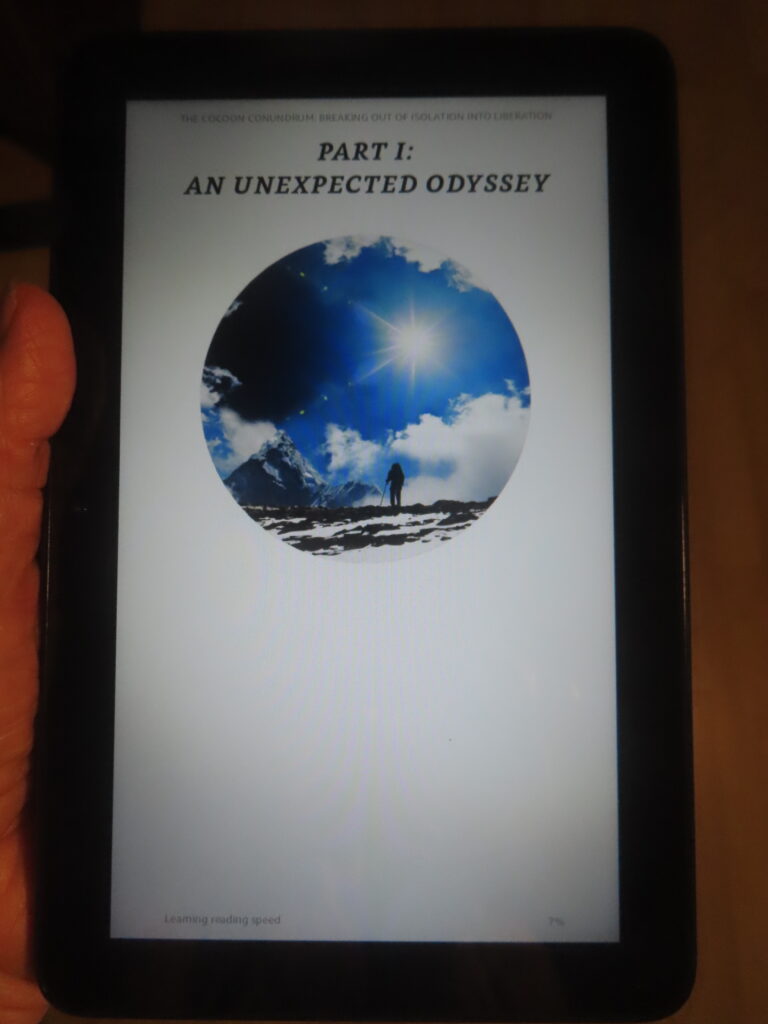
PART I: AN UNEXPECTED ODYSSEY
PART II: THE LIBERATION
Movie in theaters July 17th 2026
#TheOdysseyMovie
“The Odyssey” is a classic work of literature that explores themes of heroism, cunning, perseverance, and the power of homecoming. It is a foundational text in Western literature and has had a lasting influence on storytelling throughout history.
Joseph Campbell’s “hero’s journey” concept is not directly based on “The Odyssey,” but it shares common stages and archetypal elements found in this ancient epic and many other heroic narratives. These stages include the call to adventure, trials and challenges, meeting with a mentor or goddess, and the hero’s return home. While not specific to “The Odyssey,” the hero’s journey is a universal framework for understanding and creating heroic stories.